Home
> Musings: Main page (this page)
> Archive
| Introduction
| e-mail announcements
| Contact
Musings: 2026 (current posts)
Musings is an informal newsletter mainly highlighting recent science. It is intended as both fun and instructive. See the Introduction, listed below and in the navigation bar at the top, for more information.
In mid-2023, Musings transitioned to a new format, for a semi-retirement phase. With some adjustments, it is now similar to the earlier "briefly noted" format. The format is flexible, and contributions can be in various formats by agreement.
If you got here from a search engine... Do a simple text search of this page to find your topic. Searches for a single word (or root) are most likely to work.
Introduction (separate page).
This page:
Current posts -- 2026
New items
June
May
April
March
February
January
Older items are on the archive pages, listed below.
All pages:
Most recent posts (this page)
2026 (this page)
2025
2024
2023:
January-April
May-December
2022:
January-April
May-August
September-December
2021:
January-April
May-August
September-December
2020:
January-April
May-August
September-December
2019:
January-April
May-August
September-December
2018:
January-April
May-August
September-December
2017:
January-April
May-August
September-December
2016:
January-April
May-August
September-December
2015:
January-April
May-August
September-December
2014:
January-April
May-August
September-December
2013:
January-April
May-August
September-December
2012:
January-April
May-August
September-December
2011:
January-April
May-August
September-December
2010:
January-June
July-December
2009
2008
Links to external sites will open in a new window.
New items
No further posts are planned.
June 2026
Announcement
June 25, 2026
This is the final Musings post.
I will continue to do light maintenance, at least for a while. So do let me know of problems. That includes text errors and things that are not clear. It may include science issues, if they seem important. If there is a new development that might change the perspective, let me know. That includes retractions. It is fundamental that science is always "in progress".
Thank you to all!
Can algae make the streets safer?
June 24, 2026
Asphalt gives off volatile chemicals, broadly called volatile organic compounds (VOCs). It's quite obvious if you are nearby when a street is being paved. But emissions continue -- over the lifetime of the pavement. Some of those emissions are toxic.
A team of scientists has been exploring variations in the composition of asphalt. The work includes looking at the use of materials derived from biological sources, such as wood or algae.
Such changes could have immediate environmental benefit, by substituting renewable materials for some of the standard fossil fuel materials.
But maybe there is more benefit...
In one recent article, the scientists report that the use of material derived from algae leads to a reduction in the emission of the more toxic VOCs. This presumably involves chemical interaction between these VOCs and the algal material.
Intriguing results. The authors are exploring practical applications.
* News story: Is asphalt bad for our health? And can algae help? (Linda Stewart, The Microbiologist, April 22, 2026.) A useful overview of the broad area of asphalt problems. It discusses multiple recent articles, including, briefly near the end, the current one.
* The article: Selective removal of toxic VOCs by algae-derived biochar dramatically reduces the toxicity of asphalt emissions. (Elham H Fini et al, Clean Technologies and Environmental Policy 28:136, April 21, 2026.)
An article from late last year, with a different use of algae to improve asphalt...
* News story: Reengineering Asphalt Performance with Algae Derived Binders. (Anthony Davis, HighwaysToday, December 25, 2025.)
* The article: Algae Asphalt to Enhance Pavement Sustainability and Performance at Subzero Temperatures. (Mohammadjavad Kazemi et al, ACS Sustainable Chemistry & Engineering 13:19496, November 17, 2025.)
A post about VOCs: Photocatalytic paints: do they, on balance, reduce air pollution? (September 17, 2017).
A post that might be, in part, about road safety: Why the bear used the overpass to cross the highway (May 11, 2014).
Risk issues with fasting may vary with age -- and may be greater for older people
June 17, 2026
Intermittent fasting (IF) refers to a variety of ways of reducing overall food intake, by designating certain periods for restricted food intake. A variety of IF routines have been shown to lead to weight loss.
A new article looks at the results more closely. The scientists review all available data sets, and the more detailed data that may be available in them.
A key concern that arises is that older people (over age 60) who use IF may lose too much muscle mass. That is, they may indeed lose weight, but do it in an undesirable way.
The authors suggest that such people should include increased protein intake and muscle-building exercise in the IF routines. They also suggest that the issue needs more study. At least, older people who use IF should seek medical monitoring.
The review also raises some concern about the effect of fasting on cholesterol. This is not clear at this point, with some seemingly inconsistent results. For now, it is probably good that those fasting have their cholesterol level checked.
* News story: Fasting after 60 changes more than waistlines, exposing a trade-off many dieters never see coming. (Sayan Tribedi, Medical Xpress, June 5, 2026.)
* The article (open access): Age-Specific Analysis of the Effects of Intermittent Fasting on Body Composition and Cardiometabolic Markers in Healthy Adults and Individuals with Overweight or Obesity: A Systematic Review and Meta-Analysis of Randomized Controlled Trials. (Kaijun Xing et al, Nutrients 18:1799, June 3, 2026.)
I have listed this post on my page Internet resources: Biology - Miscellaneous under Nutrition; food and drug safety.
A simple mutation that leads to a "genetic female" developing as male
June 10, 2026
Sexual development is complicated. (And it has become political.) Let's look at a recent scientific development.
The first thing people learn nowadays is that a Y chromosome leads to maleness.
XX = female, XY = male. Common. But not everyone fits the common pattern. X0, where the 0 indicates that there is no second sex chromosome, leads to female. That suggests a positive role for Y in determining maleness. (That is for mammals. In the insect Drosophila, X0 is male, indicating a different pathway for determining the male/female choice.)
Scientists have made progress in learning how Y determines maleness. A key step is that Y carries the SRY gene, which turns on the male pathway.
If SRY has 'jumped' to X, then Y does not determine maleness. That is another example of why we need to be careful in using the common pattern.
How does SRY turn on the male pathway? The key step is that the SRY protein, in turn, turns on the SOX9 gene. SOX9 is then more directly involved in turning on the genes for male development.
If that is true, one might predict that there could be genetic changes directly affecting SOX9 expression and thus affecting choice of male/female development -- independent of SRY.
That prediction has now been tested, in a model system in mice. What the scientists did was to modify a regulatory region that controls SOX9. In a recent article, they modified it to increase SOX9 expression, independent of SRY. What they found was that XX mice (no SRY) with this modification developed as male -- because SOX9 was expressed at a high level.
In an earlier article (2024), they did the opposite. They modified the SOX9 regulatory region so that SOX9 was not made even if SRY was present. What they found was that XY mice (with SRY) with this modification developed as female -- -- because SOX9 was blocked.
Overall, the work shows that SRY can be bypassed -- by mutations that directly affect SOX9. In these cases, maleness is determined by whether or not SOX9 is expressed, not by presence of a Y chromosome or the SRY gene.
This is for mice. What about humans? The connection between SRY and SOX9 seems similar in humans and mice. The authors note that there are some known cases of XX males where there has been some suspicion about a direct effect on SOX9. With the current mouse work as a guide, such cases can be studied further.
Caution... The "big story" here is the complexity of how sexual development is determined. I put one term in quotation marks in the title to indicate that the term is more complex than it sounds. "Genetic female", in common usage, refers to one criterion, that the sex chromosomes appear to be XX. There are other simplifications along the way. Again, the big story is the complexity.
* News stories:
- One letter DNA change switches sex development in mice. (News-Medical.Net (Bar-Ilan University), April 9, 2026.) Good overview of the current work.
- Tiny DNA Edits Can Flip Gender. A small change in DNA can switch genders - female to male and male to female. (William A Haseltine, Psychology Today, April 15, 2026.) Good overview of the current understanding of sex determination in mammals.
* The article (open access): A single-nucleotide enhancer mutation overrides chromosomal sex to drive XX male development. (Elisheva Abberbock et al, Nature Communications 17:3186, April 9, 2026.)
Previous post exploring the details of sex determination in mammals: The role of dietary iron in sex determination in mammals (July 16, 2025).
Can computer modeling reveal the secret of a Stradivarius violin?
June 3, 2026
The violins made by Antonio Stradivari in the early 18th century are among the most prized violins. Why are they so good? We really don't know.
A recent article takes a new approach to uncovering the secrets of elite violins: computer simulation, using the laws of physics. That is, the goal is not to get the computer to sound like a good violin, but to understand how the violin works.
Several years ago, scientists made a rather detailed set of CAT scans of a Strad from 1715. The current work started with importing those scans into the computer, as the base to work with.
What did they learn from this? Here are the final two sentences of the Abstract... "Via high resolution spatial computations on and around the violin, significant variations are found in acoustic power flow from key violin components across frequency. These are found to propagate outward and lead to variations in radiated sound intensity at the position of a listening player or audience member over frequency, which can be large for small changes in either."
Not very exciting at this point. It's early-phase work. Intriguing work. Will it lead to better violins? We'll see.
So far, the work is only for plucked strings (pizzicato). Bowing is a more complex way to make sound, and beyond the current work.
* News stories:
- Scientists Model Sound Physics of a 300-Year-Old Stradivarius and It Could Change How Violins Are Made -- You can now hear what a 300-year-old violin sounds like if you alter its wood and other factors. (Tibi Puiu, ZME Science, May 4, 2026.)
- MIT engineers' virtual violin produces realistic sounds -- Based on the physics of how the instrument produces sound, the model could help violin makers in the design process. (Jennifer Chu, MIT News, April 29, 2026.)
* The article (open access): Exploring the behavior of a strung computational Stradivarius violin. (Arun Krishnadas et al, npj Acoustics 2:13, April 29, 2026.)
Previous post about violins: Briefly noted... The salt content of great 18th century violins from Cremona (March 16, 2022).
My page Internet resources: Miscellaneous includes a section on Art & Music. There is a list of related Musings posts.
May 2026
Are left-handed people more competitive?
May 20, 2026
It's well-known that about 10% of people are left-handed. Why? We don't know -- either how it happens, or whether there might be some biological advantage of it.
A recent article provides some statistical evidence that "lefties" are more competitive than "righties".
The work started with screening a large group of people, and choosing two subsets: one strongly right-handed and one strongly left-handed. Those groups were given a battery of personality tests; the main finding was that the lefties were more competitive.
What do we make of this? I'm inclined to be cautious. We have a report. It's consistent with some previous work. It's an interesting piece of evidence -- about a complex issue. Over time...
The article contains much interesting discussion of handedness issues, including possible evolutionary significance. This can all be fun to read if you want some such discussion. My conclusion is simply that you should not expect resolution at this point. It is certainly an interesting topic.
* News story: Left-Handers Are More Competitive Than Right-Handers -- A new study investigates the association of left-handedness and competitiveness. (Sebastian Ocklenburg, Psychology Today, February 24, 2026.)
* The article (open access): Assessing the link among laterality, sex and competitiveness to verify the evolutionarily stable strategy of handedness. (Giulia Prete et al, Scientific Reports 16:9454, February 17, 2026.)
More about handedness: On being ambidextrous (January 24, 2010). Links to more.
Did Thomas Edison make graphene?
May 13, 2026
While on graphene (previous post, just below), let's look at an interesting historical note.
Famously, Thomas Alva Edison invented the incandescent light bulb -- back in the 19th century. Early Edison light bulbs used carbon filaments. A lot of energy went into those carbon filaments during light bulb use.
In recent times, the lab of Jim Tour at Rice University has also been heating carbon filaments, leading to making graphene. They realized that their method was similar to Edison's, so decided to check. Indeed, if the modern lab heated carbon filaments the way Edison did, they got graphene. The conclusion is that Edison probably made grapheme -- back in 1879. Of course, Edison had no knowledge of grapheme, and no reason to suspect he had made a new material.
* News stories:
- Did Edison accidentally make graphene in 1879? -- Rice University chemists replicated Thomas Edison's seminal experiment and found a surprising byproduct. (Jennifer Ouellette, Ars Technica, January 24, 2026.)
- Rice researchers replicating Edison's 1879 light bulb experiments show graphene may have been unintentional by-product. (Rachel Leeson, Rice University, January 22, 2026.)
* The article: Evidence for Graphene Formation in Thomas Edison's 1879 Carbon Filament Experiments. (Lucas Eddy et al, ACS Nano 20:1769, January 20, 2026.)
Previous post about graphene... It is the post just below, mentioned at the top here.
How toothbrushes with graphene oxide kill bacteria (May 6, 2026).
A post about the Tour lab making grapheme using their "flash joule" method: Briefly noted... Turning trash into graphene (October 28, 2020). Links to another post with more information about the method.
For more Edison: Poetry (July 23, 2009). Links to more, but I don't see anything about his work on light bulbs.
But a variety of posts about light bulbs are listed at... Light bulbs (July 1, 2009).
Posts about graphene are listed on my page Introduction to Organic and Biochemistry -- Internet resources in the section on Aromatic compounds.
How toothbrushes with graphene oxide kill bacteria
May 6, 2026
There is a new type of toothbrush on the market -- based on a derivative of graphene: graphene oxide (GO). Such toothbrushes have a strong anti-bacterial activity, without being harmful to people.
A new article uncovers the basis of that specificity.
It is actually fairly simple: The GO interacts with POPG, which is widely found in bacterial cell membranes -- but not found in mammalian membranes.
POPG? It is a phospholipid: palmitoyloleoylphosphatidylglycerol. The name is a mouthful, but POPG is just a specific example of a common type of lipid in membranes. It is based on glycerol, esterified with two fatty acids and a phosphate. The two fatty acids are palmitic and oleic acids.
The current work was done largely with lipid vesicles (artificial cells) in the lab. The membrane composition could be varied as desired. This work led to recognizing the importune of the direct interaction of GO and POPG, leading to membrane disruption.
The finding may encourage people to develop further applications of GO as an antibacterial agent.
Will bacteria mutate to become resistant to GO? Apparently, such resistance has not yet been seen. It is possible that POPG is so important to bacteria that they cannot dispense with it. Nevertheless, it is a concern to consider.
We also lack information on hw lipids similar to POPG might behave.
* News stories:
- KAIST Researchers Unveil Technical Principles Behind Antibacterial Graphene Toothbrushes with 10 Million Units Sold. (Korea Advanced Institute of Science and Technology (KAIST), March 26, 2026.)
- Researchers examine how graphene oxide selectively kills bacteria while remaining biocompatible. (Roni Peleg, Graphene-info, March 29, 2026.)
* The article (open access): Biocompatible but Antibacterial Mechanism of Graphene Oxide for Sustainable Antibiotics. (Sujin Cha et al, Advanced Functional Materials, in press.)
Among posts about GO: Water desalination using graphene oxide membranes? (April 29, 2017).
Added May 13, 2026.
Next graphene post: Did Thomas Edison make graphene? (May 13, 2026). The next post, immediately above.
Posts about graphene are listed on my page Introduction to Organic and Biochemistry -- Internet resources in the section on Aromatic compounds.
April 2026
Can lab gloves contaminate measurements of microplastics?
April 29, 2026
Scientists often wear gloves in the lab. The gloves protect the hands from the lab materials -- and also protect the lab materials from the hands. The gloves are usually some kind of plastic. Is it possible that the gloves might actually be a source of contamination, if the purpose of the work is to measure plastics. This might be of particular concern if the purpose is to measure the tiny bits of plastic often called microplastics.
Seems like an obvious concern. People have considered it before, but the details are always open to further work. A new article explores some of the issues.
The detailed results are probably not of general interest. Suffice it to say that the scientists did find that certain kinds of gloves could cause significant contamination. If nothing else, the work here should alert those in the field to more carefully consider the possibility of such contamination.
The "Conclusions" section of the work is good. I encourage people to look it over (page 10 of the pdf).
* News stories:
- U-M Study Finds Nitrile and Latex Gloves Could Lead to Overestimating Microplastic Pollution. (Bioengineer, March 29, 2026.) (The size "5 millimeters" near the start of this story should be "5 micrometers".)
- Scientists may be overestimating the amount of microplastics in the environment - and the culprit is lab gloves. (Anne McNeil & Madeline Clough, The Conversation, March 26, 2026.) From two of the authors of the article. Useful overview of the work.
* The article (open access): Avoiding and reducing microplastic false positives from dry glove contact. (Madeline E Clough et al, Analytical Methods 18:2914, April 16, 2026.)
Also see: History of plastic -- by the numbers (October 23, 2017). This is a general post on plastics, with links to much more, including some posts on microplastics.
Developing a laser saw for cutting bones
April 14, 2026
Cutting bones with a saw works, but is messy. Could we do better -- with a laser? People have tried, but this alternative has its own problems.
A new article explores one issue with laser saws: the shape of the laser beam. It is the general nature of light beams that they are most intense in the center. But for cutting bone, it might be better if the beam were more intense around the edge.
The work involves controlling the shape of the laser beam. And indeed a beam with the shape of a top hat does better than the usual laser beam. It can cut faster, and can cut further into the bone in a controlled lab test with a bone on the table.
The modified laser beam still does not work nearly as well as a more conventional saw, but it is an interesting development. The scientists think they have more ways to improve the laser saw.
* News story: Breakthrough laser technology enables deeper, more efficient bone surgery. (News-Medical (University of Basel), February 26, 2026 .)
* The article (open access): Influence of laser beam intensity profile on deep bone ablation in laser osteotomy. (Mingyi Liu et al, Scientific Reports 16:7101, February 3, 2026.)
Also see:
* Laser tools... Colloidal microswimmers: 3D printing a micro-boat (December 13, 2020).
* Saws... How to eat if your jaw looks like a circular saw -- a follow-up (March 8, 2015). Good picture at the background post there.
Exploring the potential of aluminum(I) compounds as replacements for expensive metals
April 6, 2026
The Al3+ ion is familiar. In fact, it is the only common form of aluminum, other than the metal itself.
However, Al does have other oxidation states (charges or apparent charges); they are typically highly reactive. A new article reports "trapping" Al(I) (Al in the +1 state) in a form where it is relatively stable, but usefully reactive. Al(I) compounds are not entirely new, but the current work seems a promising step.
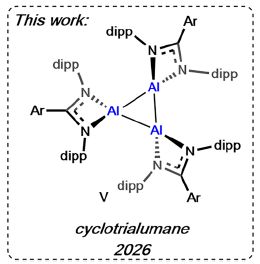
The article reports making the following chemical...
|
Note the ring of three Al in the middle. Each Al there is in the +1 oxidation state.
"Ar" and "dipp" refer to aromatic groups. They are identified at the upper right of Figure 2, on the same page of the article.
This is the lower right part of Figure 1 from the article. Other parts of the figure show some Al(I) species reported previously, dating back to 1991.
|
The authors develop their Al(I) compounds (two of them; very similar), and show that they have good stability and solubility properties. They also use these new compounds in a couple of simple model reactions, and show that they work well. A start.
The work here is interesting for two reasons...
* Al(I) is uncommon. Thus the work reveals some novel chemistry.
* In the background there is some vision that Al(I) might be able to replace expensive metals currently used as catalysts. These include the noble metals platinum and palladium, and others in that region of the periodic table. Aluminum is abundant and inexpensive. That is, the novel chemistry might actually be useful. Note that the role of the Al(I) chemicals shown here is not catalytic. However, it is plausible that the Al products can be recovered.
* News story: New Form of Aluminum Unlocks Cheaper and More Sustainable Catalysts. (Adrian Michaels, Engineeringness, February 24, 2026. Now archived.)
* The article (open access): A neutral cyclic aluminium (I) trimer. (Imogen Squire et al, Nature Communications 17:1732, January 30, 2026.)
Also see:
* Aluminum... Briefly noted... A Swiss army knife for catalysis (February 15, 2022).
* Platinum... Breaking C-F bonds? (October 26, 2018). Links to more.
March 2026
Can artificial intelligence (AI) predict partner violence?
March 25, 2026
Partner violence describes the abuse of one partner in a relationship by another partner. Spousal abuse is a major sub-class of partner violence -- and is an important social issue.
Don't worry about the variant terms for the phenomenon. The authors use "intimate partner violence" in the title of their article. I shortened it a bit. If there are issues of exactly what is meant, that is in the details of the models.
A new article explores the use of artificial intelligence (AI) for predicting partner violence.
In some ways, perhaps this is now a typical AI story. A model is trained on a database of past cases and controls. (The authors make three models in this work, and test them individually and in combination.) The trained models are then run on a new cohort; each model picks out certain people who, according to the medal, are at higher risk for partner violence.
Did it work? The authors have followed some test cohorts for a few years. Simplified, the models were about 80% accurate. And the predictions could be as early as three years before the event of concern. A good start.
What does one do after identifying that a person seems at high risk for partner violence? Not an easy question. But having the risk assessment will lead to ideas for what to do -- and testing them. Further, scientists will need to address the underlying data used to train the models. What are its limitations -- and biases? How might we improve the data set used for training?
It is an interesting development -- accompanied by lots of questions.
The work here is entirely with women, both for training the model and testing. The authors note that 1/3 of women will experience partner violence at some point. One news story also notes that 1/10 of men will experience partner violence.
* News stories:
- Researchers develop AI tool to predict patients at risk of intimate partner violence. (NIH (US), March 13, 2026.)
- Researchers Develop AI Tools For Early Detection of Intimate Partner Violence. (Mass General Brigham, March 13, 2026.)
* The article (open access): Leveraging multimodal machine learning for accurate risk identification of intimate partner violence. (Jiayi Gu et al, npj Women's Health, 4:15, March 13, 2026.) (Reminder: the prefix npj on the journal name means Nature Partner Journal.)
Previous AI post: What if your clothes could listen to what you say? (December 10, 2025).
If someone sees another post on issues related to partner violence or such, please let me know.
Bat viruses: bat types vary in their potential as a source of human pathogens
March 20, 2026
Bats carry viruses -- viruses that harm humans. We have all heard that.
A recent article looks at the situation more closely, and reports that the potential risk of harm to humans from bat viruses varies with the type of bat.
It is an interesting step. What's not clear is how robust the finding is. Time will tell.
* News stories:
- Only certain types of bats host viruses with high epidemic potential, research suggests. (Mary Van Beusekom, CIDRAP, November 4, 2025.) First item on the page.
- New study reveals not all bats carry equal viral risk. (EurekAlert! (University of Oklahoma), November 3, 2025.) From the lead institution.
* The article (open access): Viral epidemic potential is not uniformly distributed across the bat phylogeny. (Caroline A Cummings et al, Communications Biology 8:1510, October 30, 2025.)
This is the second of two consecutive posts based on recent articles on bat viruses. The first is the previous post, just below: Bat viruses: a novel deadly bat virus -- misdiagnosed as Nipah (March 18, 2026).
This post is listed on my page Biotechnology in the News (BITN) -- Other topics under Emerging diseases (general).
Bat viruses: a novel deadly bat virus -- misdiagnosed as Nipah
March 18, 2026
Bats are increasingly recognized as a source of viruses important to humans. The recent COVID-19 pandemic is just one example. Two articles from recent months discuss some aspects of the story. We note one of them here; the other is in the next post, just above.
Nipah virus, which itself originated in bats, is endemic in Bangladesh, with seasonal incidence. The heart of the new story is following five patients who were initially thought to have Nipah. However, confirmatory tests, including PCR testing for the genome, were negative for Nipah. Further work showed that they all had Pteropine orthoreo virus (PRV), a relatively unknown virus.
The work puts PRV on the map as a potentially important human pathogen. Genetic features of the virus suggest it may have considerable potential for generating new variants. In particular, it has a segmented genome (as for influenza virus). The current work should lead to raising the priority of learning to promptly detect and characterize the new virus -- not to mention learning to treat such infections.
In the meantime, don't drink the raw date palm sap.
* News story: A Mysterious Bat Virus in Bangladesh Is Deadlier Than We Thought, and Now Infecting Humans. (Mihai Andrei, ZME Science, February 3, 2026.)
* The article (open access): Bat Reovirus as Cause of Acute Respiratory Disease and Encephalitis in Humans, Bangladesh, 2022-2023. (Sharmin Sultana et al, Emerging Infectious Diseases 31:2302, December 2025.)
Added March 20, 2026.
The next bat virus post, noted at the top of this one, is just above: Bat viruses: bat types vary in their potential as a source of human pathogens (March 20, 2026).
Also see:
* Briefly noted... (April 15, 2020). Why do so many pathogenic viruses come from bats?
* Don't eat the bats. or An ALS story: Guam and New Hampshire; food chains and biomagnification; cyanobacteria, cycad trees, and flying foxes; pond scum; and BMAA. (October 6, 2009). More about one type of bat implicated here, commonly known as flying foxes.
This post is listed on my page Biotechnology in the News (BITN) -- Other topics under Emerging diseases (general).
The origin of modern European domestic cats
March 11, 2026
The origin of the plants and animals that are closely associated with humanity can make for interesting science. This time, it is the origin of the domestic cat in Europe.
It has long been suspected that wildcats came to Europe several thousand years ago, with farmers migrating from the Near East. However, a new genetic study suggests otherwise. The study of DNA samples from ancient and modern domestic cats, as well as from their likely ancestors, African wildcats, suggests that the modern European domestic cat developed from wildcats that arrived in Europe only about 2000 years ago, probably as stowaways on trade ships.
The authors caution that the data is still limited, so there may be more to the story. They welcome the availability of more old cat samples. Still. this is a fun story.
A little side story from the article... There is a population of wildcats on the island of Sardinia. These cats seem to have a separate origin, from a distinct population of African wildcats, probably a bit earlier.
* News stories:
- Ancient Genomes Show How Cats Actually Conquered the World -- Ancient genomes rewrite the story of cat domestication, showing their late arrival in Europe. (Tudor Tarita, ZME Science, December 1, 2025.)
- The domestic cat only arrived in Europe 2,000 years ago via North Africa. (Royal Belgian Institute of Natural Sciences, November 28, 2025.)
* The article: The dispersal of domestic cats from North Africa to Europe around 2000 years ago. (M De Martino et al, Science 390:eadt2642, November 27, 2025.)
Among posts about cats...
* The genetics of orange cats (September 11, 2025). And the accompanying post, about purring.
* How a cat tongue works (March 19, 2019).
An unusual neutrino, from a novel type of black hole?
March 4, 2026
In 2023 a neutrino detector on the floor of the Mediterranean Sea recorded a highly energetic event: about 100 petaelectronvolts (PeV). That's about a billion-fold higher energy than common solar neutrinos -- and about a hundred-fold higher than any other known neutrinos.
To this day, the origin of that event remains unknown.
A recent article offers some bold speculations. The general idea is that the event could have been due to the explosion of an unusual (and unknown) type of primordial black hole. What makes this primordial black hole especially unusual is that it is suggested to be made of dark matter -- including dark electrons. Evaporation of neutral material could lead to a point where the electrical repulsion exceeded the gravitational attraction. Calculations suggest that this could lead to a runaway explosion -- and to the energetic neutrino of 2023.
What are you to make of this? Well, you could smile at it. The article is openly speculative, going well beyond known physics. The authors suggest that certain things might happen -- but have no evidence that they do happen. Of course, that is the point. The work can serve as a baseline for further discussion -- and observation.
* News stories:
- Is There A Link Between Primordial Black Holes, Neutrinos, and Dark Matter? (Evan Gough, Universe Today, February 5, 2026.)
- 'Impossible' Particle That Crashed into Earth With 100,000 Times the Energy of the LHC May Actually Be from an Exploding Black Hole -- Physicists have a wild new explanation for the impossible energy spike that shouldn't exist in our universe. (Tibi Puiu, ZME Science, February 4, 2026.)
* The article (open access): Explaining the PeV Neutrino Fluxes at KM3NeT and IceCube with Quasiextremal Primordial Black Holes. (Michael J Baker et al, Physical Review Letters 136:061002, February 10, 2026.)
Posts about neutrinos include...
* A new sensor for barium ions -- could it lead to a better understanding of neutrinos? (September 20, 2020).
* IceCube finds 28 neutrinos -- from beyond the solar system (June 8, 2014). The IceCube neutrino detector is not the one that detected the neutrino of the current article -- but it is part of the story.
Posts about black holes include: Mayhem at the center of the Milky Way (August 23, 2011).
Posts about dark matter include: A galaxy that lacks dark matter? (June 12, 2018).
February 2026
Are coffee stains useful -- in electron microscopy?
February 25, 2026
Look...
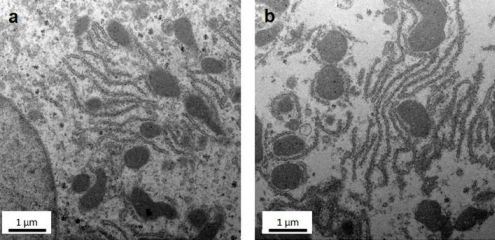
Electron microscope (EM) images of two thin-section samples from mouse liver.
Part a (left): Stained with uranyl acetate, as usual for such EM preps.
Part b (right): Stained with coffee.
This is reduced from part of Figure 1 from the article.
Not bad! And the coffee is both safer and cheaper than the traditional uranyl acetate.
Further work showed that chlorogenic acid, the suspected "active ingredient" of the coffee stain, worked well. This could lead to the use of that pure chemical as a reproducible staining agent, avoiding the variability of coffees.
The article also includes work on developing a method to quantify image quality.
The work here got started as the lead author noted the persistent dark stains in her coffee cup.
* News story: Coffee as a Staining Agent Substitute in Electron Microscopy. (Philipp Jarke, Graz University of Technology ("TU Graz"), January 8, 2026.)
* The article: Coffee - a ubiquitous substitute for uranyl acetate in staining of biological ultrathin sections for electron microscopy studies. (Claudia Mayrhofer et al, Methods 243:76, November 2025)
If you want some background on chlorogenic acid... Wikipedia: Chlorogenic acid.
Among coffee-related posts (and they link to more):
* Lab-grown coffee (March 6, 2024).
* Caffeine boosts memory -- in bees (April 12, 2013).
* Robot uses coffee as a picker-upper (December 17, 2010).
Can a person get both cancer and Alzheimer's disease?
February 18, 2026
An odd question! Why did it even come up?
Actually, there have long been reports suggesting that cancer patients have a reduced incidence of Alzheimer's disease (AD).
A new article provides evidence for how this might work. It's an interesting -- and complex -- finding. But it could offer a path to a drug against AD.
The authors of the current article use the term 'peripheral cancer'. That is, there is a brain effect of a cancer at a distant site. (I don't know if brain cancer was included in any of the background work reporting a connection.)
Most of the work here is with mice. At least some points that were checked seem to hold also for humans.
A simple version of the story is that mice with tumors show reduced levels of the amyloid plaque that is so characteristic of AD.
Testing of secretions from the tumors led to identifying a particular protein responsible for the effect. That protein is called cystatin-c (Cyst-C). Tumor-free mice injected with Cyst-C show loss of amyloid plaque -- and improvement on a mental test. Obviously, identifying a specific protein as central to the effect is a key point.
What does Cyst-C do? It clearly travels to the brain, via the bloodstream. There, two effects have been shown. One, it activates the microglia to attack amyloid plaque; sounds useful. Two, it binds to amyloid plaque. It may be that these two effects work together to deliver plaque protein to the microglia.
Back to the title question... Indeed there is an unexpected connection. The current article begins to explore how that connection works -- how having cancer could reduce AD. Fascinating -- and maybe even a lead for drug development.
* News story: Cancer tumors may protect against Alzheimer's by cleaning out protein clumps. (Paul Arnold, Medical Xpress, January 24, 2026.)
* The article: Peripheral cancer attenuates amyloid pathology in Alzheimer's disease via cystatin-c activation of TREM2. (Xinyan Li et al, Cell 189:853, February 5, 2026.) (The pdf file, including supplemental material is 51 pages.) If you get the pdf, I encourage you to read the authors' Limitations section, p 16.
More microglia: Anxiety. 2. An immune system connection (February 4, 2026). Also notes a post about a connection of AD and microglia.
This post is listed on my page for Biotechnology in the News (BITN) -- Other topics under both Alzheimer's disease and Cancer.
Do earthquakes enhance algal blooms?
February 11, 2026
One way to think about the title question might be... Sure, why not? Earthquakes shake things up. They may shake up the sea floor, leading to an upwelling of nutrients. Or the quakes may crack the sea floor, allowing release of nutrients from below.
The better question might be... Is there any evidence on the matter? And the answer to that is that a new article reports that phytoplankton blooms in one well-studied part of the ocean are larger when there has been a recent earthquake in the area.
The scene is the Southern Ocean, near Antarctica. Scientists have long observed that the algal blooms that appear each summer vary widely in size from one year to the next. Recently, the size of the algal blooms was connected to varying levels of a key nutrient: iron.
The new finning is that summers with large algal blooms were preceded (by a few months) by significant earthquakes under the ocean floor. The scientists suggest that the quakes cause deep sea vents to release iron, which -- surprisingly rapidly -- makes its way to the surface waters. The story is incomplete at this point, but a fair amount of data seems consistent with it.
I use the terms algal bloom and phytoplankton bloom interchangeably, for simplicity. What was actually measured was "net primary production", a measure of photosynthesis. That photosynthesis was due largely to tiny organisms -- commonly called phytoplankton, and consisting largely of algae
A possible big-picture implication... Larger algal blooms mean there is more photosynthesis -- and hence more removal of CO2 from the air. That leads to the possibility that earthquakes could significantly affect the level of atmospheric CO2 -- and hence climate. More information on the global distribution of the effect would be needed to evaluate the importance of this idea.
* News stories:
- The Strange Link Between Winter Earthquakes and Massive Summer Algae Blooms The Size of California -- Seafloor tremors appear to shape summer plankton blooms and carbon uptake. (Tudor Tarita, ZME Science, January 15, 2026.)
- Deep ocean earthquakes drive Southern Ocean's massive phytoplankton blooms, study finds. (Adam Hadhazy, Doerr School of Sustainability, Stanford University, December 17, 2025.)
* The article: Southern Ocean net primary production influenced by seismically modulated hydrothermal iron. (Casey M S Schine et al, Nature Geoscience 19:106, January 2026.)
Meteorites and algal blooms... A major algal bloom associated with the dinosaur extinction event? (May 13, 2016).
Among many posts about earthquakes... Earthquakes induced by human activity: oil drilling in Los Angeles (February 12, 2019). Links to more.
Anxiety. 2. An immune system connection
February 4, 2026
We now look at our second anxiety article, which finds a connection between certain cell types in the brain and anxiety disorders. (The previous post, just below, found a correlation between the level of the chemical choline in the brain and anxiety disorders.)
It's a complicated article. The two cell types are two types of microglia. These are immune system cells involved in cleaning up neurons. The big idea here is that these two types of microglia have opposite effects on anxiety responses. One type enhances the anxiety response, the other type reduces it. One might refer to them as accelerator and brake; in fat, those are the terms used by the authors.
To study this, the scientists needed to be able to manipulate the levels of these cell types. For example, in one set of experiments, they first made mutant mice lacking microglia. They could them add back one or another type of microglia, as desired for each experiment. The big picture result is that the two types of microglia had those opposite effects.
At this point, there is no understanding of how these effects occur. Nevertheless, the work suggests an important role for cells of the immune system in what we would usually call a psychiatric disorder. That in itself makes the work intriguing.
General comment on the pair of posts about anxiety...
Both posts offer some clue about what is going on. But both are small steps, and need follow-up.
The previous post focused on a nutrient (choline). That could lead to a trial to see if feeding the nutrient as a supplement affects anxiety. But we must remember that the reported effect is, for now, just a correlation. We really don't know why this is happening, and thus do not know that manipulating the choline level would have any effect.
The current post looks at the cell level. It may be a step in understanding how anxiety is modulated. But for now, it is not obvious what to do about it, except to study it more.
* News stories. The article here is complicated; both news stories here do reasonable job of guiding you through the basics. Still, don't be surprised if you get a bit overwhelmed at times.
- Scientists Discover Brain Immune Cells That Control Anxiety and Compulsive Behavior -- The study, which was carried out on mice, is a paradigm shift. (Mihai Andrei. ZME Science, November 17, 2025.) Delightful use of metaphor, along with a good overview of the work itself.
- Researchers find the "gas pedal" and "brake" for anxiety, and they aren't neurons. (Karina Petrova, PsyPost, November 18, 2025.)
* The article (open access): Defective Hoxb8 microglia are causative for both chronic anxiety and pathological overgrooming in mice. (Donn A Van Deren et al, Molecular Psychiatry 31:915, February 2026.)
Previous post about anxiety, just below: Anxiety. 1. A choline connection (January 28, 2026).
More about microglia and disease:
* Added February 18, 2026.
Can a person get both cancer and Alzheimer's disease? (February 18, 2026).
* Alzheimer's disease: a role for inflammation? (January 18, 2020). The post doesn't mention microglia, but one of the news stories listed there does.
My page for Biotechnology in the News (BITN) -- Other topics includes a section on Brain. It includes an extensive list of brain-related Musings posts.
January 2026
Anxiety. 1. A choline connection
January 28, 2026
We have two recent articles on anxiety -- on the biology behind the phenomenon. One reason for the interest is that some people have excessive anxiety responses, which can interfere with normal life. These articles could be steps toward a better understanding of anxiety, including excessive responses. One of them directly leads to considering a common biochemical to see if it might usefully modulate the anxiety response. We'll discuss that article in this post, and the other in the next post, in a few days.
The first article suggests a connection between the nutrient choline and anxiety. The basic finding is that people with anxiety disorders have lower levels of choline in the brain than typical.
That observation is based on magnetic resonance spectroscopy (MRS) measurements of the choline level in the brain. It is a complex measurement. (MRS is related to the more familiar MRI (magnetic resonance imaging).) The article is actually a review of 25 studies on the matter -- with a total of only about 350 people in each group: test and control.
This may be an interesting finding. But the authors stress that the reason for the connection is unknown. It could be an accidental correlation, with minimal functional significance. Scientists will follow up the current work, both trying to understand the connection, and testing whether choline supplements might be of benefit. They do caution that taking chorine supplements at this point would be premature, unless with medical supervision. Choline has complex roles in the body, and is not without risk.
* News story: Low Choline Could Be a Hidden Driver of Anxiety. (Neuroscience News (Lisa Howard, University of California Davis), November 10, 2025.)
* The article (open access): Transdiagnostic reduction in cortical choline-containing compounds in anxiety disorders: a 1H-magnetic resonance spectroscopy meta-analysis. (Richard J Maddock & Jason Smucny, Molecular Psychiatry 30:6020, December 2025.) Review article.
A previous post about the complexity of choline: The importance of choline as a dietary nutrient (April 15, 2023). Again, this is about work with mice.
Added February 4, 2026.
Next post about anxiety, just above: Anxiety. 2. An immune system connection (February 4, 2026).
More about anxiety: Should you give Librium -- an anti-anxiety drug -- to crayfish? (October 6, 2014).
My page for Biotechnology in the News (BITN) -- Other topics includes a section on Brain. It includes an extensive list of brain-related Musings posts.
The oldest known RNA
January 14, 2026
A new article reports isolating RNA from a woolly mammoth sample, about 39,000 years old.
That is a surprise. Scientists have developed ways to isolate DNA and protein from very old samples; some examples reported in Musings are listed at the end. However, ancient RNA has been much more elusive. It has seemed likely that most RNA would be degraded by ubiquitous nucleases within hours after death.
It is not clear why the particular sample used here yielded meaningful RNA sequences. Unusually good preservation of the sample, especially immediately after death, is one likely factor. Some technical issues of the isolation procedure also may have contributed.
The work does provide some information about gene function in the woolly mammoth. Some of the RNA could be clearly identified as to the protein it encoded. For example, some of the genes that were active in the muscle sample were muscle genes. Not a very exciting finding, but a start. There was also evidence for expression of genes involved in stress response, suggesting that the animal had been injured.
The article may be of interest mainly for making the step, rather than for any particular findings at this point. It will give impetus to further work looking for RNA in ancient samples. The RNA reported here is more than twice as old than the previous record holder. But it is quite young compared to old DNA and protein that have been found.
* News stories:
- This 39,000-Year-Old Mammoth Holds the World's Oldest Preserved RNA -- An extinct animal's RNA reveals muscle stress in its final moments-after 39,000 years. (Tudor Tarita, ZME Science, November 24, 2025.)
- Scientists recover 40,000-year-old mammoth RNA still packed with clues -- Researchers decoded 40,000-year-old mammoth RNA, unlocking real-time biological secrets frozen since the Ice Age. (Science Daily (Stockholm University), November 15, 2025.)
* The article (open access): Ancient RNA expression profiles from the extinct woolly mammoth. (Emilio Mármol-Sánchez et al, Cell 189:52,
January 8, 2026.)
Examples of posts on old molecules...
* Briefly noted... The oldest known sequenced DNA: another new record (December 13, 2022). DNA, two million years old. And the post links to an earlier one about a genome from a million-year-old mammoth.
* Evidence for dinosaur protein extended by a hundred million years (May 12, 2017). Protein, 190 million years old.
Using a tardigrade protein to reduce radiation damage during cancer treatment
January 7, 2026
The tiny animals known as tardigrades (or "water bears") are resistant to various stresses, including radiation. A specific protein has been identified that confers that radiation resistance. It is called Dsup, for damage-suppressor. It binds tightly to DNA, somehow leading to reduced DNA damage during radiation. It seems to be unique to tardigrades.
Previous work showed that human cells engineered to produce that Dsup protein were indeed radiation resistant. That is, the tardigrade protein that reduces radiation damage can function in human cells. No ill effects were seen.
A recent article takes another step toward making real-world use of that tardigrade protein.
The idea is to use the Dsup protein to reduce damage to nearby (healthy) areas when a cancer is being treated with radiation. To do this, the scientists have developed a way to deliver the messenger RNA (mRNA) for Dsup protein to cells in those nearby areas. It is something like an mRNA vaccine, delivered directly to the target area. The mRNA functions, providing radiation resistance to those areas -- without affecting the radiation treatment itself.
Tests in a model system of mouse cancer, reported in the current article, are very encouraging in showing reduced damage from the radiation treatment. Development of this system will continue, with the goal of using it safely in humans during radiation treatment of cancer.
* News story: A protein from tiny tardigrades may help cancer patients tolerate radiation therapy -- When scientists stimulated cells to produce a protein that helps "water bears" survive extreme environments, the tissue showed much less DNA damage after radiation treatment. (Anne Trafton, MIT News, February 26, 2025.)
* The article: Radioprotection of healthy tissue via nanoparticle-delivered mRNA encoding for a damage-suppressor protein found in tardigrades. (Ameya R Kirtane et al, Nature Biomedical Engineering 9:1240, August 2025.)
A recent post on another type of tardigrade resistance: Tardigrade resistance to stress -- how do they do it? (March 27, 2024). Links to more.
Older items are on the archive pages, starting with 2025.
Top of page
Older items are on the archive pages, starting with 2025.
E-mail announcements -- information and sign-up: e-mail announcements. The list is now being used only occasionally.
Contact information
Site home page
Last update: July 13, 2026