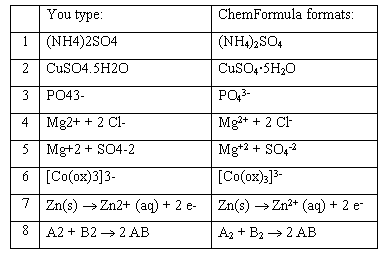
ChemFormula, a macro for Microsoft Word to help format chemical expressions.
Periodic table handout.
Kit for making your own "buckyballs".
Chemistry practice problems. (separate page) Includes links to all chemistry problem sets at this site, such as practice quizzes, tests and homework. Also includes some Self-help worksheets for selected introductory chemistry topics.
Molecular biology problems.
Class handouts.
Please let me know if you have trouble accessing any files; sometimes, your comment is the way I find out that there is a problem.
Bottom of page; return links and contact information.
ChemFormula is a macro that works in Microsoft Word for Windows. ChemFormula allows you to type chemical formula expressions without worrying about formatting; ChemFormula will add formatting features, such as subscripts, superscripts, and raised dots.
The following table shows some examples of what ChemFormula does.
ChemFormula is now available at the web site of the primary author, Greg Pearce: http://www.gregpearce.co.uk/chemformula/
This is my periodic table (PT) handout. I made it for Intro Chem students to use on tests.
This PT corresponds to the PT in the Intro Chem textbook I use, with the following modifications:
* It includes the names of the elements (as well as symbols). I think this is particularly useful for new chem students.
* I have updated it to show new names that have been approved or at least are under official consideration. These include the names for elements up through #118. See Names of elements section of my page of Internet Resources for Intro Chem.
* I have updated it to show new elements that have been reported. For more about these, see the sections of my page of Internet Resources for Intro Chem for New chemical elements (112 and beyond), Elements #113 and 115, Element #117, and Element #118. #118 was announced in October 2006; #117 in February 2010. (I have not included element 122, for which a discovery claim was made, April 2008. See section Element #122.) Those sections contain links to relevant posts in my Musings newsletter; this may all get consolidated into the first of those sections.
Download periodic table handout: pt.pdf. Updated to show the names for 113, 115, 117 & 118. These names have been officially approved.
This is a PDF file, for viewing with Acrobat Reader. It prints on one page, but it is very crowded, to get the element names on. Please let me know of problems. (If anyone wants the source file, please contact me. It is currently an OpenOffice file, but that can be converted to a Word DOC file.)
A form of carbon that has attracted considerable attention in recent years is "fullerene". The main molecule in this family, C60, is more formally known as buckminsterfullerene, though the nickname "buckyballs" is common.
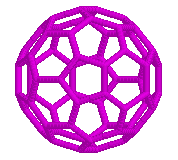
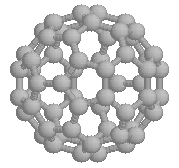
Now, you can make your own buckyballs. All you need are two copies of the following figure, some scissors, and some tape or glue.
The buckyball kit [link opens in new window]. (buckykit.gif)
Instructions? Print out two copies of the figure. Then cut out the drawings, around the outer boundary. Fold and tape.
Thanks to Dr. Chen Tsai, math and engineering instructor at Contra Costa College, for suggesting this kit.
For a Musings post about buckyballs, see: The smallest water bottle (January 5, 2011).
Homework problems were included in each chapter handout. Molecular Biology chapter handouts.
Sample tests: Molecular Biology sample tests.
The molecular biology problem sets have not been maintained recently. Nevertheless, many of the questions are "timeless", and should still be useful.
Most of these handouts are my chapter notes to accompany the textbook.
Class handouts: Chemistry (Intro, General) Introduction to Organic and Biochemistry Principles of Molecular Biology
Home page for Musings (newsletter -- current science) Intro Chem (X11) Organic/Biochem (X402) Biotechnology in the News (BITN) Molecular Biology
Writing, drawing and viewing chemical formulas Chemistry practice problems
Contact information Site home page
Last update: January 5, 2020